
2026-27
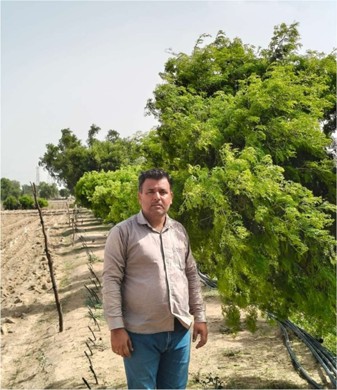
Cultivating Prosperity by growing Thar Shobha Khejri: A Success Story of Mr. Mukesh Kumar Pareek:
Khejri (Prosopis cineraria), the state tree of Rajasthan, plays a vital role in sustaining livelihoods in hot arid region.
Traditionally, farmers in the region maintained indigenous khejri trees; however, these local varieties/genotypes often posed several challenges,
including excessive thorniness, tall plant stature, long gestation period and lower production of sangri and fodder. Mukesh Kumar Pareek,
38 years old farmer from Dholera village of Bikaner district, Rajasthan had been growing traditional khejri trees on his 2 hectare farm for
many years but was dissatisfied with their limited productivity and management constraints.
He came in contact with ICAR-Central Institute for Arid Horticulture (ICAR-CIAH), Bikaner in 2010, where he was introduced with the improved
khejri variety 'Thar Shobha', motivating him to adopt scientific khejri plantation practices with the aim of increasing his income.
Before the adoption of Thar Shobha, Mr. Pareek cultivated high-yielding varieties of ridge gourd, kachri, and other vegetable crops of the
institute using improved practices. In 2015, he established a khejri based horticultural cropping system by planting quality material (improved)
obtained from ICARCIAH and integrating vegetable intercrops to enhance farm productivity and sustainability. ICARCIAH conducted field
demonstration of improved variety of Thar Shobha on the field of Mr. Pareek and advised to develop khejri orchard through in-situ
budding technique. He started the work with 200 khejri plants and he received additional support from ICAR-CIAH in the form of 50 plants
of the improved khejri variety 'Thar Shobha' under the NABARD-funded Farm Sector Promotion Fund Scheme. Motivated by the positive outcomes
of the intervention, he gradually expanded the plantation to nearly 2,000 budded plant trees of Thar Shobha. Today, his khejribased agroforestry
model serves as an example of sustainable and climate-resilient farming in the arid region. The plantation was managed using drip irrigation
and low-cost, eco-friendly practices, including the application of biogas slurry, cow urine, organic manure, and mulching with khejri fodder.
The successfully integrated arid-region intercrops such as tinda, kakdiya, and kachri, generates an additional annual income of around Rs. 2-3 lakh.
The adoption of improved khejri cultivation has significantly enhanced the productivity and sustainability of Mr. Pareek's farming system.
Mr. Pareek have received an additional annual household income of approximately ?4 lakh through the sale of buds from nearly 1,000 selected trees
under contractual arrangements with nurseries producing 'Thar Shobha' planting material. It also yielded additional net income of around
Rs. 2-3 lakh annually from intercrops grown within the plantation system. The annual maintenance cost of the khejri
plantation is estimated at Rs. 70,000-80,000
owing to the low input requirements of khejri and its minimal susceptibility to pests and diseases. The system also yielded improved quality
and quantity of fodder and mulch material. The environmental benefits include enhanced soil health through increased organic matter, improved w
ater-holding capacity, reduced soil erosion, and higher soil carbon content. Moreover, it created rural employment opportunities, with one family
engaged in managing farm operations under a 25% profit-sharing arrangement.
Reflecting on his experience, Mr. Pareek emphasizes that khejri cultivation requires minimal management and carries relatively low production
risk, making it highly suitable for arid and semi-arid regions. He observed that although budded plants initially exhibited slower growth compared to
in-situ budded plants, their long-term performance and market demand have been highly rewarding. Mr. Pareek strongly recommends the cultivation of the
improved khejri variety 'Thar Shobha' to farmers in hot arid regions. "Thar Shobha is environmentally friendly, requires less management, and
provides better income opportunities. Farmers should adopt this improved variety to enhance their livelihoods while conserving the environment."
Today, Mr. Pareek's khejri-based farming system stands as an inspiring example of how scientific interventions, improved planting material, and
integrated farming practices can transform traditional agriculture into a profitable and sustainable enterprise in the arid regions of Rajasthan.
(Manpreet Kaur, S.R. Meena and D.K. Sarolia )
2024-25
Bahar management technique in pomegranate cv. Bhagwa for hot arid climate: A success story
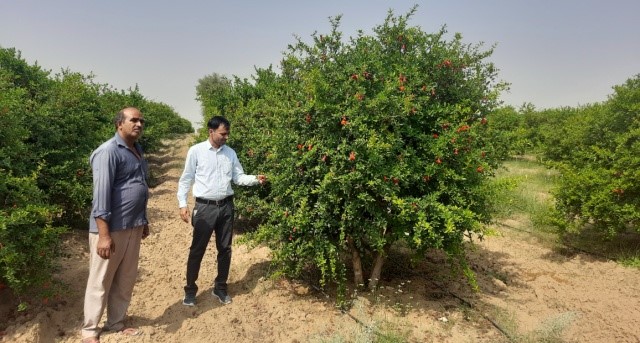
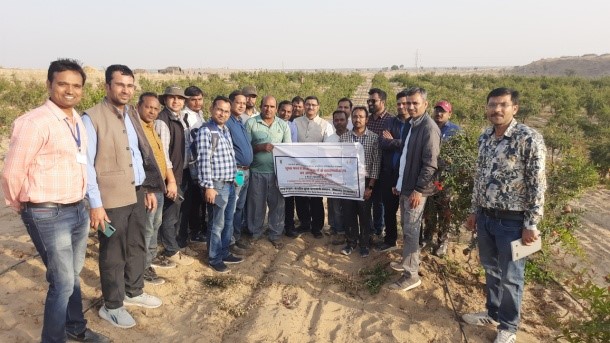
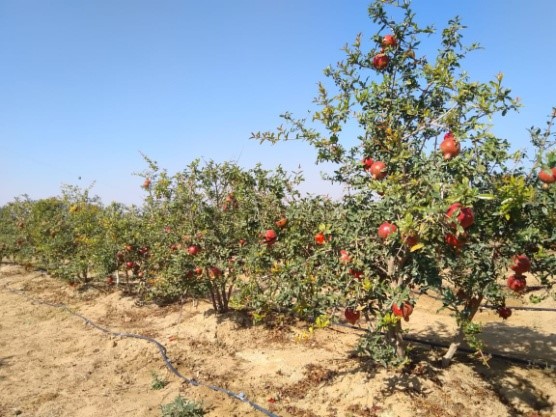
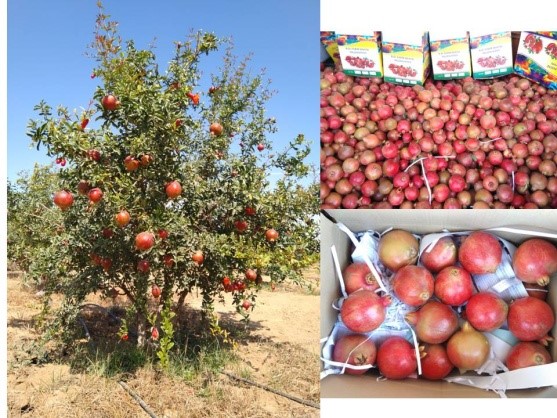
Pomegranate is an emerging fruit crop of hot arid regions. Naturally, it bears flowers continuously from February to November particularly in three bahars (ambe, mrig and hasta) in a year which results staggered harvesting, low yield, poor quality, and high fruit-cracking incidence. Therefore, ICAR-CIAH, Bikaner has standardized “Bahar management technique in pomegranate cv. Bhagwa for hot arid climate” which includes imposition of water stress for one month (June-July) followed by light pruning (removal of terminal growth 10-15 cm) and ethrel 1-2 ml/l + NPK (0:52:34 grade) 5 g/l application for defoliation. It can be preponed/postponed for 20-30 days for early/delayed harvesting according to market demand, frost and pest-disease incidence. This technology resulted in synchronize flowering, stimulate more female flowers, higher fruit yield, improved rind and aril colour with low fruit-cracking. This technology is popularized among farmers by conducting field demonstrations, trainings and interactions meetings and adopted by farmers. Among them, Mr. Jai Bhagwan Dahiya, (Vil. Kanasar, Bikaner) adopted this technology and obtained 12.49 t/ha marketable fruit yield with good aril and rind red colour fruits with lower fruit cracking (<5%). He sold fruits @ Rs. 40-50/kg and gained net profit around Rs. 3,30,000/ha. Another progressive farmer, Mr. Harendra Sihag, (Vil. Palana, Bikaner) was applied bahar treatment and obtained 12.91 t/ha marketable fruit yield with quality and less cracking (<5%). He sold fruits @ Rs. 42-65/kg and gained net profit around Rs. 3,60,000/ha.
(Ramesh Kumar and Jagan Singh Gora)
Entrepreneur from Gujarat getting benefit of jamun variety Goma Priyanka (CHES, ICAR-CIAH)
The potential of Goma Priyanka has been demonstrated at farmers field, Gautam Patel, from village of Chandrala, Gandhinagar under hot semi-arid conditions in Gujarat. He planted 150 grafted plants of Goma Priyanka in his field, recorded 20 kg fruit/plant during 5th year of planting under dry conditions and earned ₹ 50000.
Bael products-based enterprises in Gujarat (CHES, ICAR-CIAH)
As a result of demonstration of bael technology, the farmer of village Dabhoda Gandhinagar, shri Ranchhodbhai Patel, established the 100 grafted plants of Goma Yashi at his farm purely under rainfed conditions. He has earned ₹ 40000 during 5th year. The farmers of surrounding area were also inspired by seeing the performance of bael on his field. Now the technology is spreading in Gandhinagar, Gujarat with gradually increasing demand for planting material.
Smt. Hansa Jain w/o Nirmal Jain started processing and development of value added products of bael. At present, fruit concentrate, candy and squash are being prepared and sold in the name of ‘Perk Foods’ at Balajinagar, Sanchor-343041, Rajasthan. She is earning 1l lakhs annually and they got motivated by the experts of CIAH, Bikaner and its regional station CHES, Godhra.
2010
The snap melon (Cucumis melo var. momordica) is a popular arid vegetable crop and now this crop is cultivated commercially both as rainy and summer season crop due to new innovative technologies developed by ICAR-CIAH, Bikaner in this field. The farmers of Bikaner district and nearby areas gave feed back that Snap melon varieties viz. AHS-10 & AHS-82 released by the Institute were very good and performing well on their fields. The yield potential of these varieties ranged from 176-255 q / ha on varying levels of technological adoption. The farmers are earning an average net income of > Rs. 37000 / ha / season by growing them. Demand of these varieties is very high amongst the local farmers. In farmers view, the variety- AHS-82 variety is superior to AHS-10 variety of snap melon. The fruits of variety AHS-82 are most liked by the consumers and its demand is very high as farmers responded. They further responded that the fruits of variety AHS-82 are uniform, attractive and very tasty. It is very much suitable for preparing dry slice locally called Fofalia (a value added product) and used for vegetable / Chatani preparation or mixing in other vegetables for acidic taste. Moreover, the farmers also responded that by growing these varieties on barren land, the soil erosion can be reduced and organic matter in the soil can be increased. However, the farmers told that the lack of awareness, low and erratic rainfall, poor quality of ground water, lack of good quality of water, non availability of seeds of these varieties on time, etc. are the major problems in expanding the area under above improved varieties
2011
Kachri Variety- AHK-119 and AHK-200 : The institute has released two improved varieties of kachri (Cucumis Spp.) named as AHK- 119 and AHK–200. These varieties, especially AHK-119 are cultivated commercially both as rainy and summer season crop. The feedback from the farmers of Bikaner district and nearby areas was collected about the performance of the above varieties. The farmers who grow these varieties responded that the variety AHK-119 is superior to AHK-200. The demand of this variety is very high amongst the farmers as well as consumers in local areas / cities. This variety is highly suitable for growing under hot arid climatic conditions. By growing this variety, the farmers are earning an average net income ranging from Rs.36,000-42,000 / ha / season depending on management aspects and climatic conditions. The fruits of variety AHK-119 are unique in shape, size, taste, colour and very attractive in look. It is very much suitable for preparing Chutney, dry powder, pickle, sauce and mixing with other vegetables for acidic taste as told by the farmers and consumers. Moreover, the farmers also responded that by growing these varieties on barren land, the soil erosion can be reduced and organic matter in the soil can be increased. However, the farmers told that the non availability of seeds of this variety (AHK-119) in desirable quantity on time is the major constraint in expanding the area and increase the production of this variety
Production and income generation potential of Kachri Variety- AHK- 119 : A Success story : A farmer, Sh. Uda Ram Kaswan S/o Sh. Adu Ram Kaswan,, Village-Kesar Desar Jatan, Tehsil- Bikaner, District- Bikaner, Rajathan, grows kachari variety- AHK-119 on his field every year/ season, continuously from the year 2003. He is very happy and likes very much to grow this variety on his field during both summer as well as rainy season of every year. An interview was conducted with Sh. Uda Ram Kaswan and he responded that AHK-119 variety of kachri released by ICAR-Central Institute for Arid Horticulture, Bikaner, Rajasthan is a wonderful variety. It is a unique and first kind of kachri variety which can be grown twice in a year, gives high production and highly suitable in hot arid climatic conditions. He further explained “under the guidance of Scientists of ICAR-Central Institute of Arid Horticulture, Bikaner, I am growing this variety on my field right from the year 2003. It is grown by me as a summer season crop between 20 February to 28 February and as a rainy season crop between 15 June to 15 July, every year. Under the guidance of scientists of this Institute, I am following the scientific method of kachri production and I achieved a production between 80 – 100 quintal fresh fruit of AHK-119 variety per hectare per season in preceding years. After grading and good packing, I sell these kachri fruits in local vegetable mandies (vegetable markets) of Bikaner and Nagaur city. Last year, I sold them in local vegetable markets (mandies) with an average price of Rs. 14 per kg as fresh fruits (Rs. 1400/- per quintal fresh fruits). By selling the fresh fruits of AHK- 119 directly in the mandies, I received gross income of rupees ranging from Rs. 1, 12,000 to 1, 40,000 per hectare per season during preceding years. The average total cost of production of above kachri per hectare per season was Rs. 25000. Thus, in last years, my net income from production of AHK- 119 variety ranged between Rs. 87000 to 112000 per hectare per season.” He further elaborated that the fruits of variety AHK -119 are unique in shape, size, taste, colour and very much attractive in appearance. It is highly suitable for preparing, vegetable, chutney, dry powder, pickle, and mixing with other vegetables for acidic taste, etc.
2012
Biscuits of date palm fruits: The Institute prepared the biscuits of date palm fruits at doka stage. The fruit pulp was dried in oven and grinded to make it powder. The biscuits of this powder were prepared with wheat flour as a binding agent. The purpose of preparation of these biscuits is to provide the preserved energetic food with high nutritional value to human being. Organoleptic test was made by visiting farmers, experts and local consumers.
They liked these biscuits very much and appreciated their taste, flavor, appearance, etc. These biscuits can be stored in glass jar up to 60 days without any change in appearance and taste. These biscuits can be prepared and popularized at large scale for the commercial production.
Commercialization of seed production of improved variety of Kachri : The Institute has developed a very good variety of kachri named as AHK-119. The Institute tried to popularize this variety amongst the farmers through various extension programmes. This variety is high yielding and most suitable on farmers’ fields in hot arid climatic conditions. During an impact study, it was found that the area under this variety is increasing season by season, particularly in hot arid region of western Rajasthan. The demand of the seeds of this improved variety is very high amongst the farmers or in local markets. Hence, the local farmers have started to produce/ multiply the seed of the variety to earn money. Recently, some of the farmers in local areas have started to produce / multiply the seeds of this variety at their own field for commercial purpose under the technical guidance of scientists of the Institute and earning money by selling the seeds to other fellow farmers or in local markets.
2013
Commercialization of seed production of improved variety of snapmelon : The Institute has developed a very good variety of snapmelon named as AHS-82. The Institute tried to popularize this variety amongst the farmers through various extension programmes. This variety is high yielding and most suitable on farmers' fields in hot arid climatic conditions. During an impact study, it was found that the area under this variety is increasing season by season, particularly in hot arid region of western Rajasthan. The demand of the seeds of this improved variety is very high amongst the farmers or in local markets. Hence, the local farmers have started to produce/ multiply the seed of the variety to earn money. Recently, some of the farmers in local areas have started to produce / multiply the seeds of this variety at their own field for commercial purpose under the technical guidance of scientists of the Institute. They have started to earn money by selling the seeds of above variety of snapmelon to other fellow farmers or in local markets.
Success of In-situ budding technique in khejri : The innovative in-situ budding technique of khejri propagation as developed by the Institute was popularized among the farmers by giving practical demostration on farmer's field. The in-situ budding techniques was performed at farmer's fields on 1.5-02 years old root stock (having hight about 01.0 metre) to intiate work of developing khejri orchards or khejri based cropping system. The success for the same was > 70%. Farmers viewed this technique as woderful success and boon for the dvelopment of khejri orchards or khejri based cropping system in extreme hot arid climatic condtions, particularly in westwern Rajasthan. The farmers are very eager to adopt this technique for the plantation and production of khejri at large scale in their fields to harness the commercial properties and potentiality of the Khejri.
2014
Production and commercial potentiality of improved variety of Kachri "AHK-119" : A success story : A farmer, Sh. Mukesh Kumar Pareek S/o Sh. Satyanarayan Pareek , Village- Khinchiya (05 KHM), Tehsil- Bikaner, District- Bikaner, Rajasthan, grew kachari variety- AHK- 119 on his field on 25 June, 2014. He sowed the seeds of the variety in the month of June (early kharif sowing) under drip irrigation system in anticipation that fruiting in the crop will be early during the kharif season, which could help fetching batter price in the market. He got an average Rs. 24 / kg. of kachri fruits as against Rs. 09 / kg for summer season crop. He succeeded in getting net income of Rs. 2, 20,000 by growing the improved variety of kachri (AHK-119) on his field as early kharif crop under drip irrigation system.
An interview was held with Sh. Mukesh Pareek and he responded that AHK-119 variety of kachri released by ICAR-Central Institute for Arid Horticulture, Bikaner, Rajasthan is a wonderful variety. It is a unique and first of its kind of kachri variety, which can be grown twice in a year by managing time and farm resources properly. It gives high production and highly suitable in hot arid climatic conditions. He further explained that the scientists of ICAR-Central Institute of Arid Horticulture, Bikaner, conducted front line demonstration of this variety in his field during the year 2013-14, wherein the performance and production of this variety was impressive; besides, being remunerative. Therefore, he planned to grow the same variety early in the kharif season of the year 2014-15. Under the technical guidance of ICAR-Central Institute of Arid Horticulture, Bikaner, he grew this variety in his field.
He further elaborated that the fruits of variety AHK -119 are unique in shape, size, taste, colour and quite attractive in appearance. Therefore, the majority of the consumers prefer to purchase it. It is highly suitable for preparing vegetable, chutney, dry powder, pickle, and mixing with other vegetables for acidulous taste.
Sh. Mukesh Kumar Pareek is an innovative farmer and has very novel ideas and take windfall profits of the improved technologies. He produced not only the fruits of the improved variety of kachri "AHK-119" but also began producing the seeds to earn money. During summer season, 2014-15, he multiplied/ produced 11.00 kg seeds of the above improved variety under the guidance of the scientists of this Institute and sold the same among his fellow farmers comfortably @ Rs. 2000/- per kg.
 0151-2250147
 0151-2253123
 ciah[at]nic[dot]in